
Visual Embers
Less Is More

There is an old saying that has shaped architecture, design, music, and photography for generations:
Less is more.
Simple words. Difficult to embrace.
Nowhere is that tension more visible than in the human body.
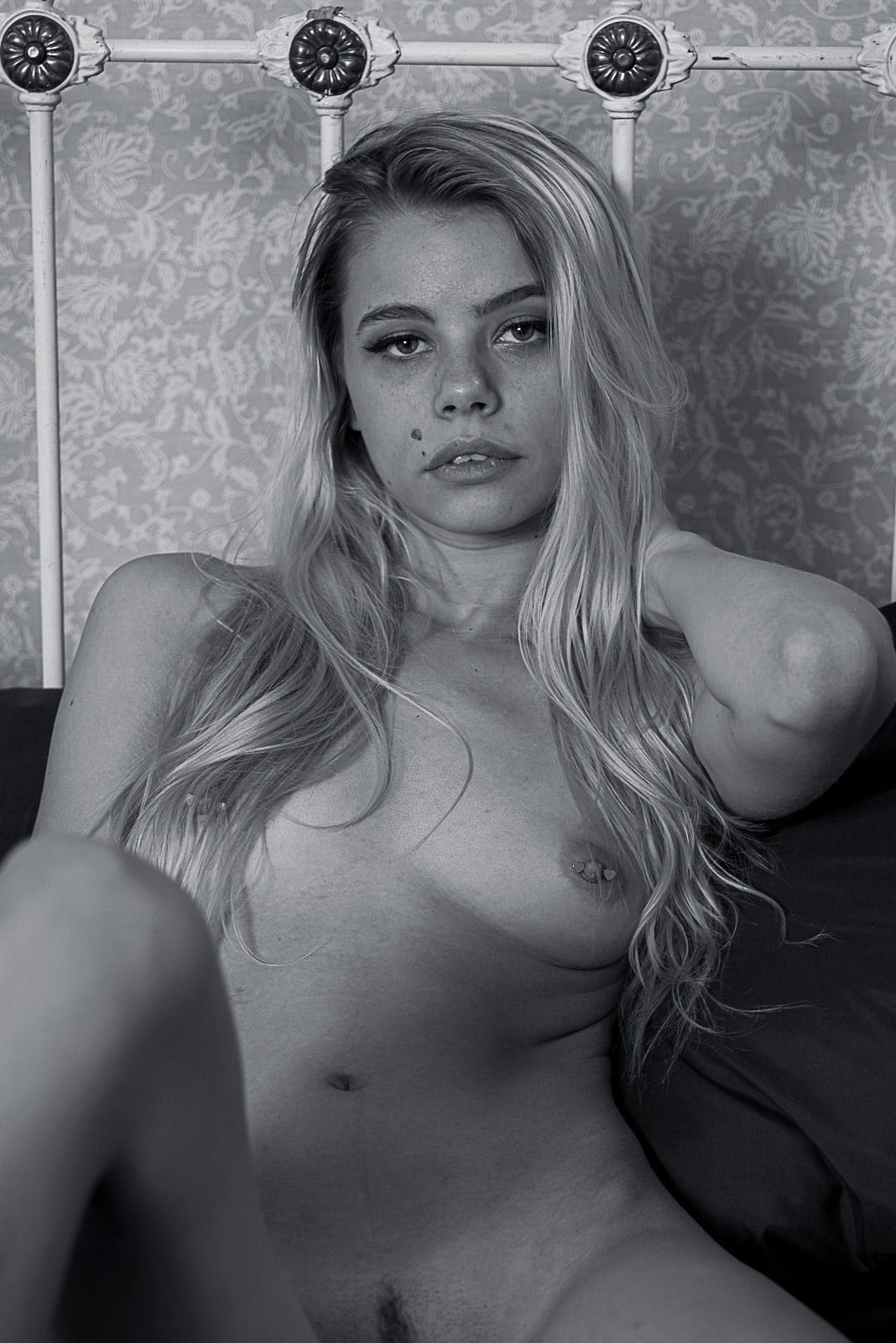
A photograph like this often divides its audience almost instantly. Some viewers see nudity first. Others see composition, light, expression, and emotion. Neither response is accidental; each is shaped by our own experiences, culture, and expectations.
For some people, less feels uncomfortable because it removes the familiar distractions.
Clothing tells stories before a person ever speaks. Fashion suggests status, personality, wealth, profession, even identity. Remove those layers and something unexpected happens.
The viewer is left with only the human being.
That can feel unsettling.
Without costume, there is nowhere for either the photographer or the subject to hide. Every expression carries more weight. Every gesture becomes intentional. Every glance feels honest.
In many ways, nudity is not about revealing more.
It is about removing everything that is not essential.
That is why I often find myself returning to minimalism—not simply in wardrobe, but in the entire frame. Soft light. A quiet room. An old iron bed. A patterned wall. No elaborate sets competing for attention.
The fewer visual elements that remain, the louder emotion begins to speak.
Some viewers immediately understand this. They recognize vulnerability before they recognize nudity. They see confidence in the model’s willingness to simply exist without performance. They experience the portrait as they would a sculpture or a charcoal drawing.
Others cannot separate the body from centuries of social conditioning. That is understandable too. Every culture teaches us different things about what should remain hidden and what should be celebrated.
Neither response makes someone right or wrong.
Art simply asks us to notice our own reaction.
When I created these portraits, I wasn’t interested in photographing perfection.
I was interested in presence.
The direct gaze. The relaxed posture. The natural texture of skin. The subtle asymmetry that reminds us we are looking at a real person rather than an impossible ideal.
This is why my Platinum Blue Lumière Embers™ process has become such an important part of my work. The restrained blue monochrome removes the distraction of color while preserving the warmth of humanity. It softens without hiding. It simplifies without reducing. It invites contemplation instead of demanding attention.
Less becomes more.
More emotion.
More honesty.
More humanity.
Perhaps that is the quiet paradox of minimalist portraiture.
The fewer things we place between ourselves and another person, the more opportunity there is for genuine connection.
In the end, these photographs are not really about nudity.
They are about trust.
Trust between photographer and model.
Trust between artist and viewer.
And perhaps, if we allow ourselves to look a little longer, trust in ourselves to see beyond what is immediately visible.
Sometimes the most revealing photographs are not the ones that show the most.
They are the ones that leave us with nowhere else to look except into another person’s humanity—and our own.
—
Created in my signature Platinum Blue Lumière Embers™ style, where monochrome is infused with subtle platinum-blue tones to create images that exist between memory, sculpture, and emotion.
#FineArtPhotography #FineArtNude #FigureStudy #Minimalism #PlatinumBlueLumiereEmbers #MonochromePhotography #BodyPositivity #ArtPhotography #CreativePortraiture ChromaticEmbers.com
I like that the prose of this article fits with your minimalist ideal of photography. Well articulated points.